By Behara Satyanarayana
The mangrove forests have been treated as destroyable wastelands until recently. However, after witnessing their magnitude of coastal protection during the Indian Ocean tsunami (24 Dec 2004), both government and non-government organizations began massive mangrove plantation projects all over the tropical and subtropical coastlines. In fact, mangrove ecosystems gained a renewed managemental attention only after this tsunami incident and since then, their conservation becomes a priority for many countries, especially in Asia.
Yet one thing is clear: mangroves are highly precious for the scientific community group than for the general public. Since mangrove wetlands do not immediately receive eye-catching attention (like what happens to coral reefs and other scenic spots), they were simply looked down for decades as muddy areas, mosquito breeding grounds and the areas for easy occupation, settlements or conversion to aquaculture/agriculture fields.
Hence, the first and foremost thing is to change people’s perceptions of mangrove habitats. Once the public started having a feel-good experience with mangrove forests, its management became efficient and sustainable. For changing the people’s viewpoint on mangroves, the concept of ecotourism was already introduced in many countries and is still a good practice where the (non-)locals are educated on mangrove goods and services, including the benefits to our future generations by preserving these wetlands.
In addition, there is a compelling need to raise and promote the ecological, social, cultural and educational benefits of the mangrove ecosystems through social media platforms (e.g. YouTube, Twitter, Facebook, Instagram, Pinterest, etc.) that usually followed by millions of people, especially the youngsters, all over the world. These social media are an excellent source for mangrove photo sharing and easy communication in which any news on mangroves can reach the public and policymakers by storm.
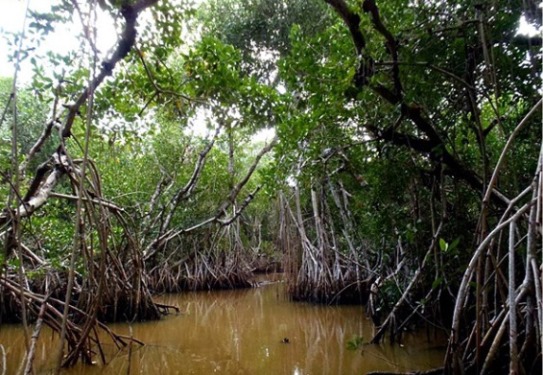
The beauty of the mangrove forests indeed lies in its ecosystem services that can only be identified after spending some time in the woods. So, let people come and appreciate the mangroves for their sustained contributions to mankind. Most recently, a few members of the IUCN Mangrove Specialist Group (MSG) and their associates have highlighted the importance of public perceptions for mangrove conservation. For details, please read “Public Perceptions of Mangrove Forests Matter for Their Conservation” by Dahdouh-Guebas et al. (2020), Frontiers in Marine Science (vol. 7: 603651)