1.Aims
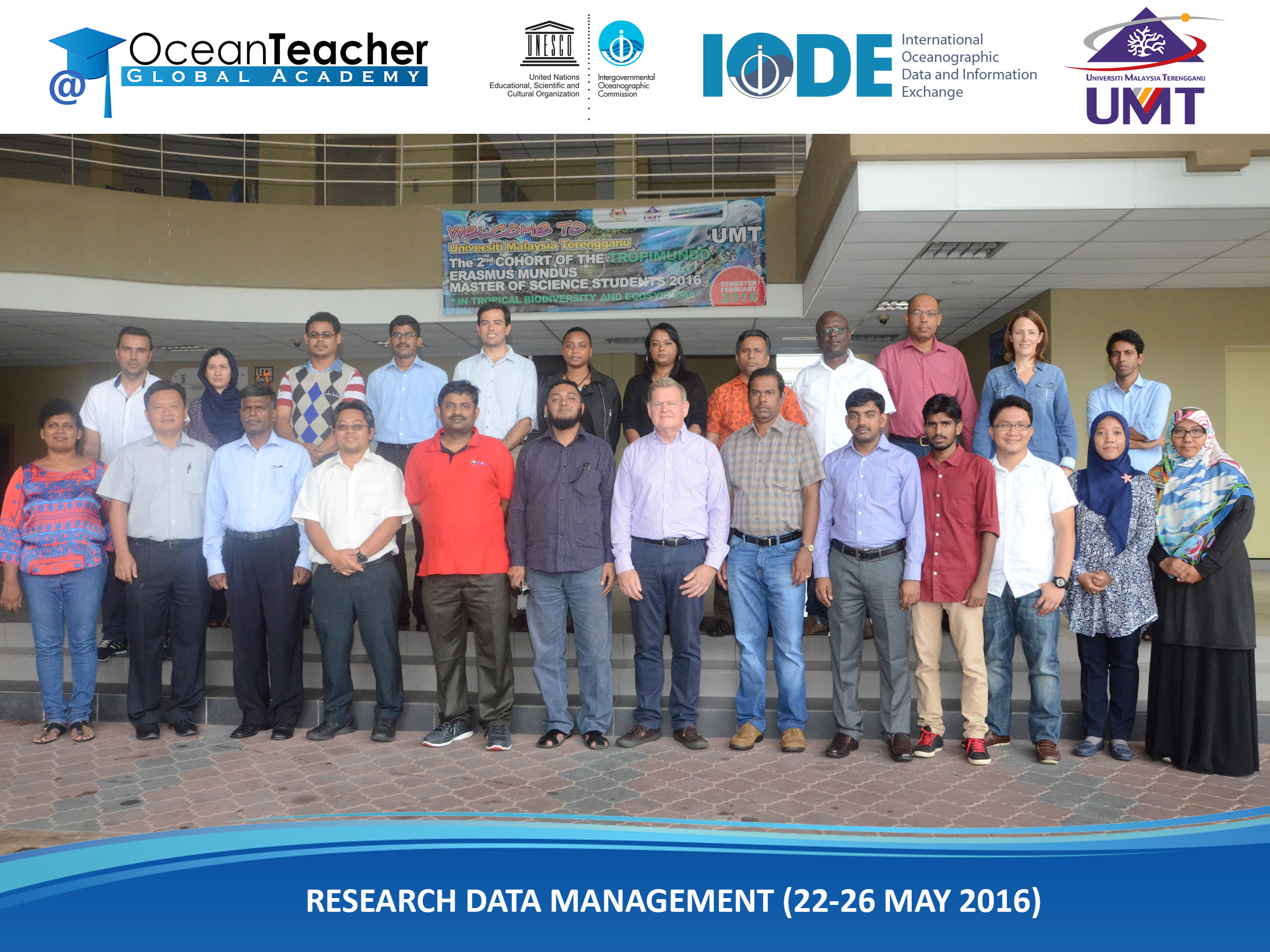
This training course seeks to bring together marine researchers, data/document managers and marine data librarians to develop an agreed approach to sound data management for all research activities conducted as part of the second International Indian Ocean Expedition (IIOE-2).
The second International Indian Ocean Expedition (IIOE-2) is a major new program of the IOC in partnership with the Indian Ocean Global Ocean Observing System (IOGOOS) Regional Alliance and the Scientific Committee for Oceanographic Research (SCOR). Over the next 5 years, a large number of IIOE-2 related research activities will collect new data on a range of physical, biogeochemical, biological and coupled climatic characteristics of the Indian Ocean. Many IORA Member States are anticipated to lead research activities under IIOE-2, or will be part of international collaborations undertaking oceanographic research. For more information on IIOE-2, refer to www.iioe-2.incois.gov.in/. Basic scientific research requires sound data management practices and one of the overarching objectives of IIOE-2 will be to support the collection and curation all data to encourage data sharing using internationally agreed rules of data exchange, and to facilitate data discovery and use in the long term.
This course, Research Data Management (RDM), will cover the planning, creating, storing, organizing, accessing, sharing, describing, publishing and curating of data in the context of IIOE-2 and its data and information management objectives. The course content has broad applicability in the field of research data management in general.
2.Objectives
The course will provide comprehensive training in research data management in order to lay the foundations for a common approach for research data management amongst researchers, repositories and facilities (inc. libraries) that manage marine data in IORA Member States, thereby helping to ensure that the data is accessible, standardized and maintained over time. There are 4 strategic objectives for the training course:
a) Strengthen regional cooperation between IORA Member States in oceanographic research and data management through the development of a common framework for research data management under IIOE-2 to facilitate increased accessibility and sharing of research data
b) Build relationships between IORA Member States and other nations engaged in IIOE-2 research activities to improve their own national capacity in areas of mutual research and data management interests
c) Advance the knowledge of IORA Member States in current international best practice in research data management standards and tools
d) Promote women’s participation in research data management activities.
| Location | Institute of Oceanography and Environment Universiti Malaysia Terengganu (UMT), 21030 Kuala Terengganu Terengganu, Malaysia |
||||
| Notes | Host: Government of Malaysia and the Malaysian Ocean Teacher Global Academy (OTGA) Regional Training Centre (RTC) at INOS, UMT
Supported by: Australian Aid, UNESCO/IOC Perth Programme Office, UNESCO/IOC Project Office for International Oceanographic Data and Information Exchange (IODE) and the Indian Ocean Rim Association (IORA). |
||||
[youtube height=”315″ width=”560″]https://www.youtube.com/watch?v=vlyS8sWEvuE[/youtube]