
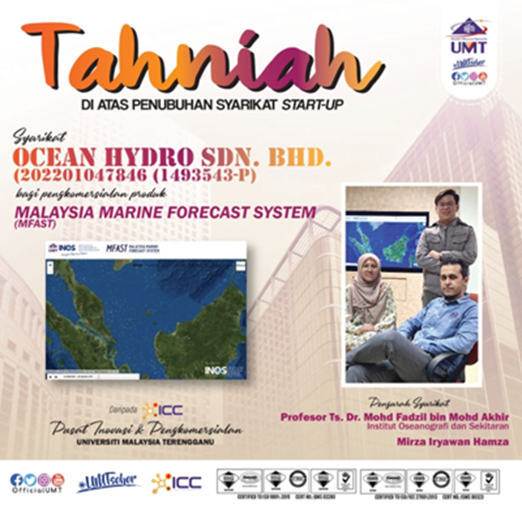

New Start-up Ocean Hydro - Aims to Make Marine Industry Safer

We are thrilled to applaud the incorporation of Ocean Hydro Sdn. Bhd. (OHSB) as an INOS-based startup company. Committed to develop innovative solutions for the marine industry with its flagship product, the Marine Forecast System (MFAST), OHSB is set to revolutionise how we predict ocean conditions and weather patterns.

Universities are hotbeds of talent, research, and innovation. By encouraging and supporting start-up companies, universities can instil entrepreneurship culture and contribute to economic growth. Indeed, the idea of a start-up within the university is exciting and practical.

OHSB is a prime example of this. The company has leveraged the resources and expertise of the university to develop a product that will significantly impact the marine industry. MFAST is a sophisticated system that uses advanced data analytics and machine learning algorithms to provide accurate and timely marine forecasts.

OHSB is now working on expanding data solutions for a wider marine industry that will involve climate change and ocean productivity data. With climate change affecting our planet and ocean health is under countless threats, there has never been a more critical time for solutions to mitigate the impacts of such. The implications of such a product are far-reaching. It will not only facilitate marine operators and decision-makers to plan their operations but will also contribute to the safety and sustainability of our oceans.

As we celebrate the establishment of OHSB and the commercialisation of MFAST, we look forward to the company’s continued growth and success. We are also proud that OHSB is being managed and run by our alumni, who have experienced the research environment at INOS. They would bring in quality and most importantly, support UMT aspirations and values. We wish them all the best in their endeavours and look forward to seeing them make impressions in the world.

Abstract

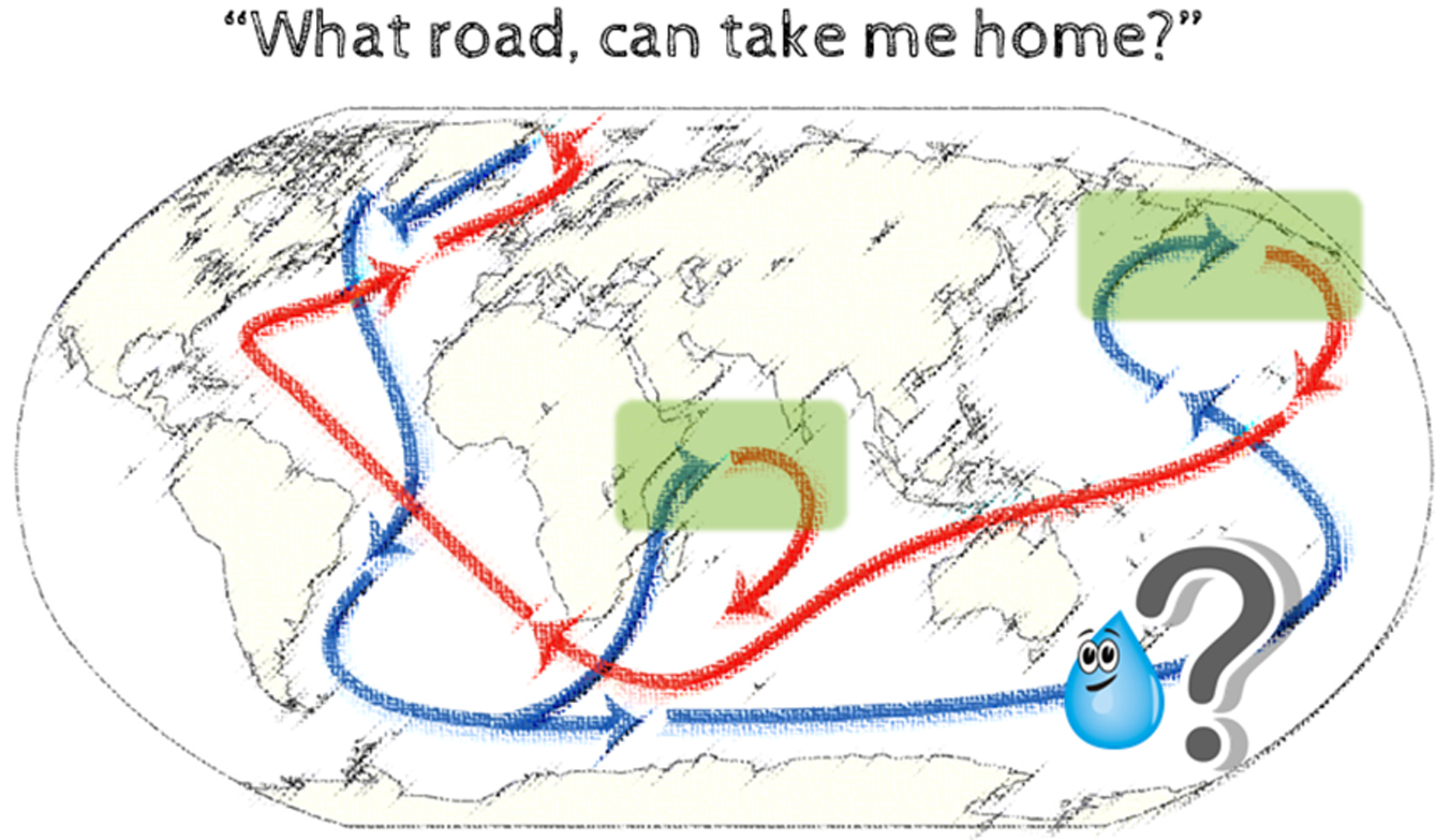
While the sinking formation of Antarctic Bottom Water (AABW) is well understood, how this bottom water "returns home" through upwelling within ocean basins, particularly the Indo-Pacific, remains shrouded in uncertainty. In the 1960s, Munk’s classic "Abyssal Recipes" theory sought to explain these abyssal flows, yet later observations exposed two significant conflicts with real-world data. In 2016, Ferrari, McDougall, and colleagues proposed the "Towards a New Abyssal Recipe" framework, introducing bottom boundary layer (BBL) upwelling to address Munk’s inconsistencies. Drawing on recent evidence of a potential cooling trend in the deep ocean, this talk revisits these debates, offering a fresh interpretation of Munk’s discrepancies and proposing a new mechanism for abyssal upwelling in the Indo-Pacific. It contributes to the ongoing quest to unravel how bottom waters complete their global journey.
Presented by: Prof. Dr. HAN Lei
Affiliation: China-ASEAN College of Marine Science, Xiamen University, Malaysia
Address: Sepang, Selangor, Malaysia



This will close in 0 seconds