
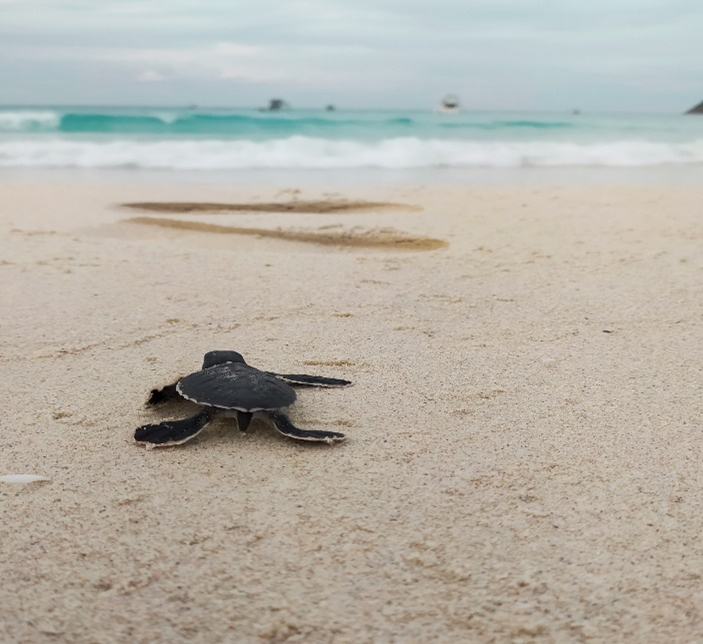

A Tale of the Monsoon Riders from Terengganu

The monsoon system helps our sea turtle to establish different populations in the South China Sea (SCS) for their survival. How baby turtle benefits from the monsoon?

The SCS exhibit two types of monsoon; the Northeast and Southwest monsoon. Sea turtle hatchlings dispersal in the ocean are highly influenced by the monsoon season. The simulated hatchlings are distributed north into the Gulf of Thailand during the Southwest monsoon, while during the Northeast monsoon, the simulated hatchlings travel south into the Java Sea. A classic theory in sea turtles’ life cycle is the ‘lost years’ of baby turtles once they get into the water and swim away from the shore. It is almost impossible to track a half palm-sized baby turtle in a vast ocean as they normally exhibit swimming frenzy behaviour to leave the shore.  The lost years will last between 15-25 years, until the sea turtle reach their maturity and return to their natal beach to reproduce.

However, the findings in 2016 by UMT on baby turtles’ energy spends when they come out of the nest has paved the way to unravel these lost years theory. We learnt from most recent research that baby turtles hatch during different monsoon seasons will form different subpopulations in the SCS. We predicted a single hatchling to swim for 7 days non-stop and go as far as 116 km through ocean modelling techniques. We now understand the role of this monsoon wind in guaranteeing this species’ survival. Although they come from the same mother, their dispersion in the ocean is determined by different currents according to the Southwest or Northeast monsoon season. This is the reason why a mother turtle can nest between 8-12 times anually – some hatchlings are set to go to the Gulf of Thailand, while the others will go to the Natuna Islands. Therefore, the sea turtle hatchling benefits from these different monsoons by building up distinct subpopulation in our big ocean.

Our research findings may be able to bring us back to the grace of Allah SWT through His amazing creation. If we continue to consume turtle eggs while this species is on the verge of extinction, we are indeed ignorant and thoughtless.

Written by:

Dr. Uzair Rusli, SEATRU, Institute of Oceanography and Environment, UMT


Abstract

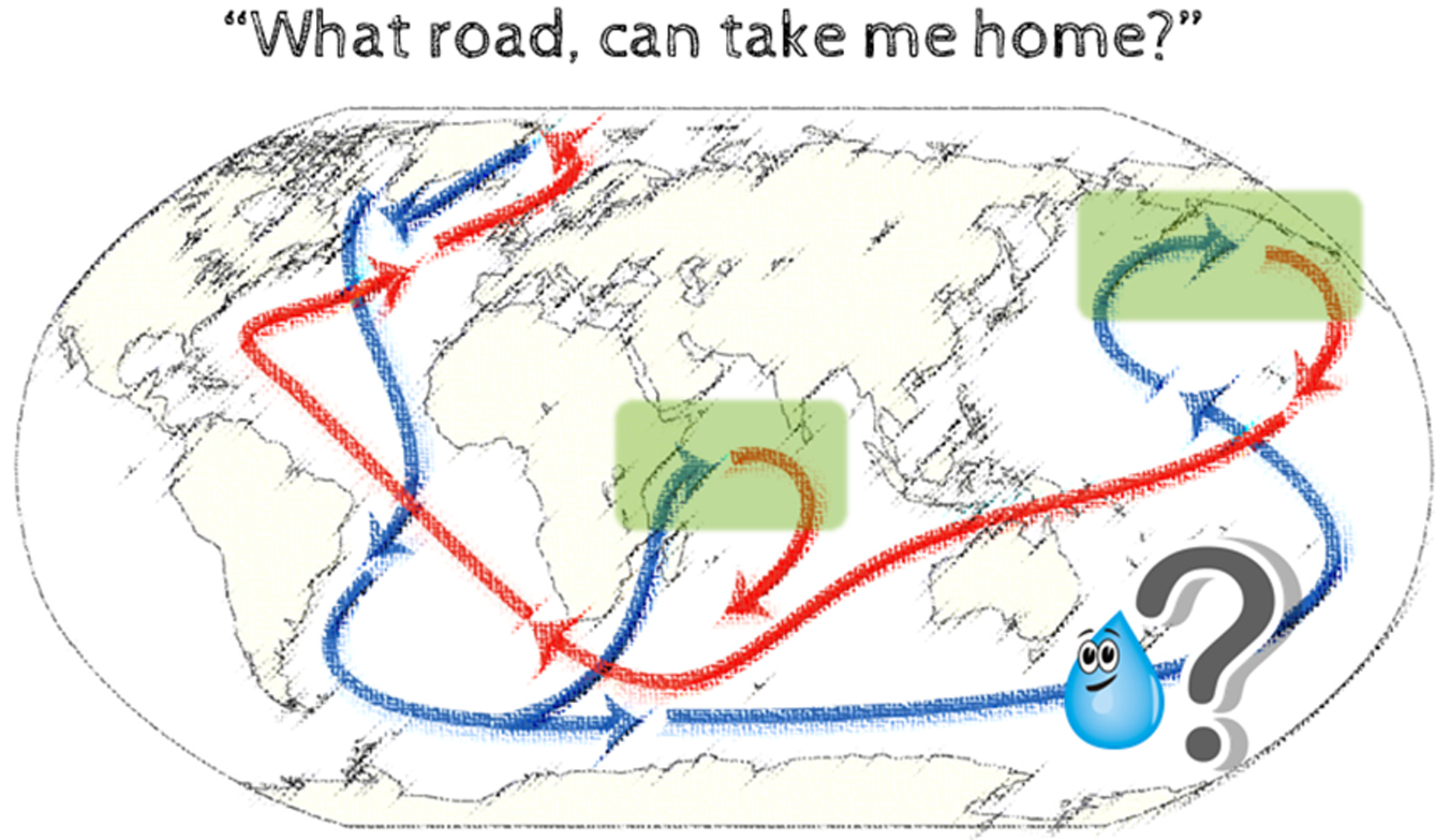
While the sinking formation of Antarctic Bottom Water (AABW) is well understood, how this bottom water "returns home" through upwelling within ocean basins, particularly the Indo-Pacific, remains shrouded in uncertainty. In the 1960s, Munk’s classic "Abyssal Recipes" theory sought to explain these abyssal flows, yet later observations exposed two significant conflicts with real-world data. In 2016, Ferrari, McDougall, and colleagues proposed the "Towards a New Abyssal Recipe" framework, introducing bottom boundary layer (BBL) upwelling to address Munk’s inconsistencies. Drawing on recent evidence of a potential cooling trend in the deep ocean, this talk revisits these debates, offering a fresh interpretation of Munk’s discrepancies and proposing a new mechanism for abyssal upwelling in the Indo-Pacific. It contributes to the ongoing quest to unravel how bottom waters complete their global journey.
Presented by: Prof. Dr. HAN Lei
Affiliation: China-ASEAN College of Marine Science, Xiamen University, Malaysia
Address: Sepang, Selangor, Malaysia



This will close in 0 seconds