INOS and NAHRIM Unite to Address Sea Level Rise and Coastal Morphological Dynamics
By INOS
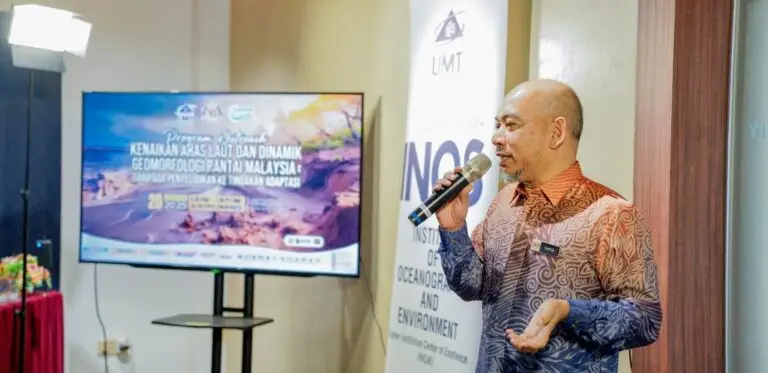
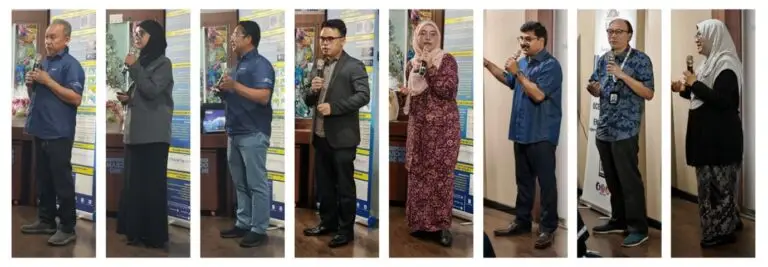
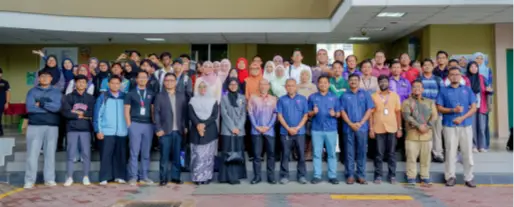
KUALA NERUS — In a proactive effort to confront climate change and escalating coastal erosion, the Institute of Oceanography and Environment (INOS), Universiti Malaysia Terengganu (UMT), and the National Water Research Institute of Malaysia (NAHRIM) organised the strategic outreach seminar “Kenaikan Aras Laut dan Dinamik Geomorfologi Pantai Malaysia: Daripada Penyelidikan ke Tindakan Adaptasi“. Held at the INOS Research Gallery, the event successfully bridged scientific data with actionable policy. Opening addresses by Prof. Dr Zainudin bin Bachok and Ts. Saiful Bahri bin Hamzah emphasised that managing sea level rise requires robust evidence and close inter-agency cooperation. The core programme featured eight distinct technical briefings on coastal resilience and community adaptation:
- Prof. Dr Zainudin bin Bachok (INOS UMT) analysed the performance of artificial reefs since the 1970s, noting a pivotal shift in 2006 toward robust reinforced concrete or steel structures and PETRONAS’s “Rigs-to-Reefs” initiatives to attenuate wave energy.
- Ir. Pn. Wan Norshuhada binti Wan Khairuddin (JPS Terengganu) detailed national trends, noting that 1,347.6 km of Malaysia’s coastline is actively eroding, and mapped JPS classification zones for critical Terengganu hotspots.
- Prof. Madya Dr Effi Helmy bin Ariffin (INOS UMT) developed shoreline projections using modelling tools, namely MIKE-21 and DualSPHysics, advocating for low-profile hybrid innovations such as E-Fence and M-Net over traditional revetments.
- Prof. Madya Gs. Ts. Dr Aliashim bin Albani (CEFORE UMT) evaluated Marine Renewable Energy (MRE) frameworks, using Extreme Value Analysis (EVA) to ensure structural reliability while supporting the delivery of green power to isolated communities.
- Puan Norasniza binti Hamzah (PLANMalaysia) shared insights into the execution of the Kampung Angkat MADANI project in Kampung Tanjung Gelam, where local knowledge successfully guided RM1.2 million in funding across 12 infrastructure projects.
- Prof. Madya Dr Behara Satyanarayana (INOS UMT) demonstrated through 10-metre-deep soil coring at the Matang Reserve that mangroves store up to five times more carbon than standard 1-metre assessments indicate.
- Prof. Madya Dr Hazman bin Samsudin (BEACON UMT) outlined the acceleration of global sea level rise (4.5 mm/year), citing a Tioman Island case study projecting RM23 billion in economic losses by 2050 to justify blue financing models.
- Prof. Dr Wan Izatul Asma binti Wan Talaat (INOS UMT) advocated for mainstreaming Ecosystem-based Adaptation (EbA) into local policy and the upcoming National Adaptation Plan (MyNAP) to secure sustained institutional funding.
The true success of this outreach program lies in the shared hope and commitment forged between researchers, policymakers, and the local community. By uniting a diverse range of approaches, from advanced engineering innovations like M-Net and applied geospatial technology to multi-layered disciplinary concepts; this seminar successfully synthesised scientific innovation with the deep, generational knowledge of coastal residents, proving that protecting Malaysia’s shores is a collective responsibility. Moving forward, this collaborative spirit provides a powerful foundation for the upcoming National Adaptation Plan (MyNAP), ensuring that future generations will inherit a resilient, thriving, and securely preserved coastal heritage.