Spill to Support:
INOS-COG on the Ground for IOPC Fund Assessment
By Muhammad Danial Noor Iskandar & Mohd Fikri Mohamad (INOS)
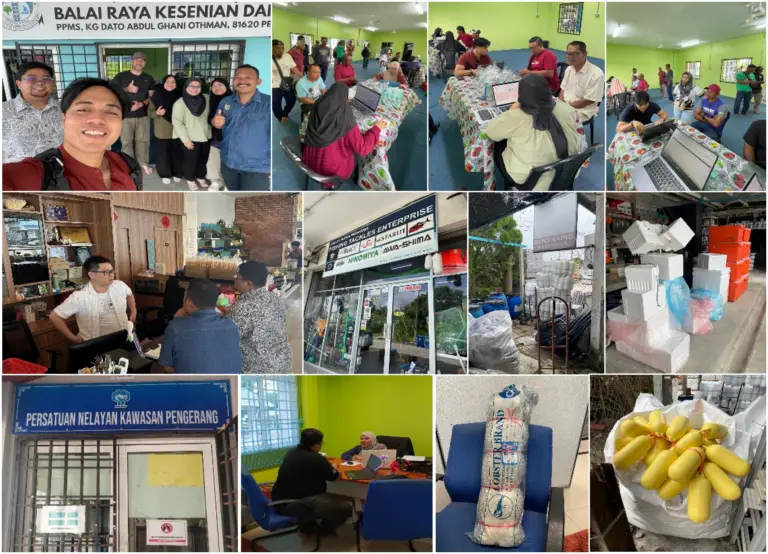
Following the Marine Honour – Vox Maxima oil spill, the INOS–COG team from Universiti Malaysia Terengganu (UMT) was mobilised as enumerators and assessors under the International Oil Pollution Compensation (IOPC) Funds to support compensation efforts for Malaysian fishers affected by the incident. The spill, which released approximately 817 m³ of oil after a tanker collision in June 2024, did not remain confined to Singapore waters; it eventually reached parts of the Johor Strait and disrupted key fishing areas around Pengerang. From 7–10 December 2025, field verification took place at the Arts and Culture Hall, Kampung Dato Abdul Ghani Othman, Pengerang, Johor, where 138 fishers came forward to have their claims assessed. The process went beyond reviewing forms—it involved direct conversations, careful cross-checking of documents, and a close look at each fisher’s fishing records and reported losses. In many cases, formal documentation such as receipts was limited or unavailable, reflecting the realities of small-scale fisheries. To address this, the team relied on a triangulation approach, combining site visits to landing points, restaurants, and wholesalers with market price comparisons, consultations with local fishermen associations (PNK), and verification with fishing gear suppliers. Informal engagements with fish dealers and middlemen—those who handle daily fish transactions—added another layer of insight, helping to anchor the assessment in real, day-to-day practices. Through these interactions, a clearer picture of the community emerged. Most claimants were full-time fishers operating in nearshore waters, dependent on traditional methods such as drift nets, and many belonged to lower-income groups. For them, fishing is not just a job—it is the backbone of their daily livelihood. The team assessed claims across economic loss, fishing gear damage, and vessel-related impacts, applying a consistent framework that linked catch data, fishing frequency, and market prices to estimate actual losses. Interestingly, it became evident that many fishers had understated their losses, with assessed values often exceeding what was originally claimed. At the same time, challenges arose from informal practices—gear purchased without receipts, repairs done incrementally, and transactions carried out through middlemen. Rather than treating these as limitations, the team worked around them, using local price references and supplier data to ensure that each assessment remained fair, grounded, and reflective of real conditions on the ground.