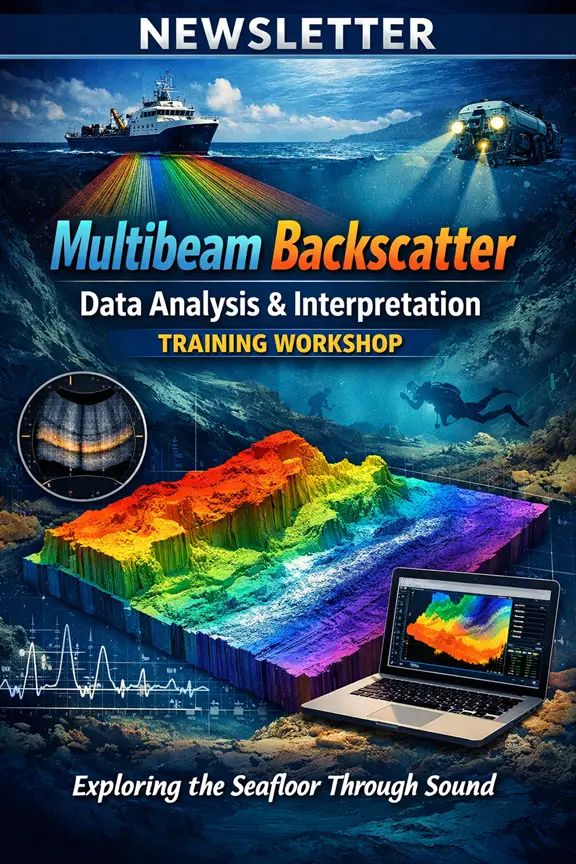
Multibeam Backscatter Data Analysis & Interpretation Training Workshop
By Azizi Ali (INOS)
The Institute of Oceanography and Environment (INOS), Universiti Malaysia Terengganu (UMT) successfully organised a five-day Multibeam Backscatter Data Analysis & Interpretation Training Workshop (23th – 27th of November 2025), involving 22 participants from various government agencies and academic institutions.
The workshop was funded by the Department of Minerals and Geoscience Malaysia (JMG) and jointly supported by the National Hydrographic Centre (PHN), Department of National Heritage (Jabatan Warisan Negara – JWN), Universiti Teknologi Malaysia (UTM), with INOS, UMT serving as the main organiser.
Sharing Knowledge and Practical Experience- Learning from Experts
The training sessions were delivered by a team of experienced lecturers and researchers:
Ts. Dr. Azizi Ali, Dr. Khaira Ismail, Dr. Rozaimi Che Hasan, Assoc. Prof. Dr. Fatin Izzati Minha, and Gs. Dr. Muhammad Hafeez Jeofry. Their combined expertise provided participants with both strong theoretical understanding and valuable hands-on experience.
What Did the Participants Learn?
The workshop content was carefully structured to guide participants from basic concepts to practical applications. Key topics included:
- Introduction to acoustic surveys and marine data
- Datums, map projections and coordinate systems
- Backscatter theory in multibeam surveys
- Hands-on backscatter data processing
- Introduction to Angular Range Analysis (ARA)
- Practical ARA exercises
- Ground-truthing and sediment data interpolation
- Practical sessions using ArcGIS, including exporting backscatter, ARA and ground-truth data
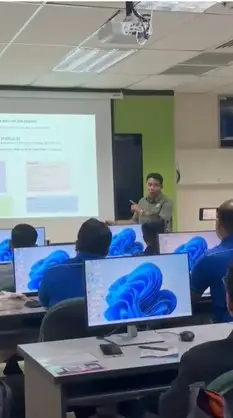
Participants were also introduced to industry-standard software such as QPS FMGT and SonarWiz, widely used in hydrographic and seabed mapping studies.
Workshop Objectives
The main objectives of the training were to:
- Introduce participants to the fundamentals of multibeam echosounder (MBES) and backscatter technology
- Provide hands-on experience in processing and interpreting multibeam backscatter data
- Demonstrate the integration of backscatter and bathymetric data for seabed characterisation
- Familiarise participants with commonly used industry software for backscatter analysis
Overall, the workshop successfully enhanced participants’ technical skills while strengthening collaboration between government agencies, universities and research institutions. This training reflects INOS, UMT’s continued commitment to capacity building and knowledge sharing in marine mapping and hydrographic sciences.
From Theory to Practice
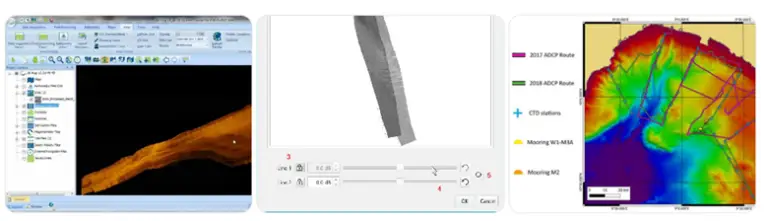
The workshop was designed to be practical and hands-on. Participants learned step by step, starting from basic concepts and moving towards real data analysis. Topics included:
- Introduction to acoustic surveys and marine data
- Datums, map projections, and coordinate systems
- Basics of multibeam backscatter theory
- Hands-on backscatter data processing
- Introduction to Angular Range Analysis (ARA)
- Practical ARA exercises
- Ground-truthing and sediment data interpolation
- Using ArcGIS to integrate backscatter, ARA, and ground-truth data
- Industry-standard software such as QPS FMGT and SonarWiz was used throughout the training.
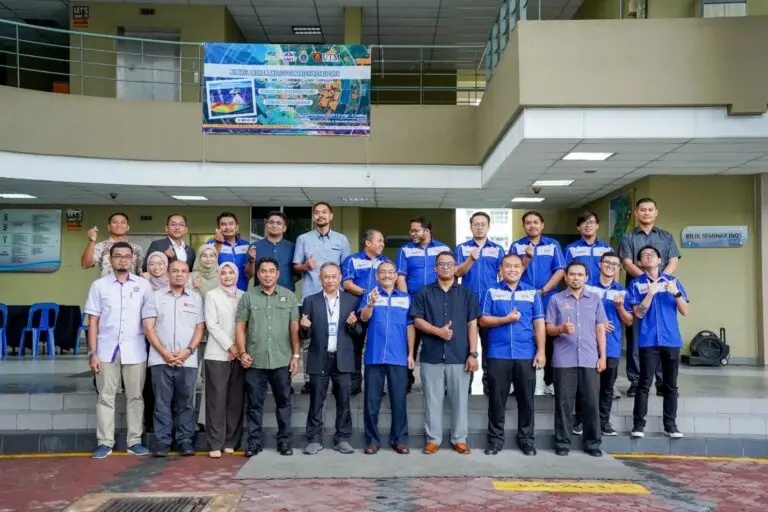
The workshop successfully provided participants with new skills, practical experience, and confidence in handling multibeam backscatter data. It also strengthened collaboration between government agencies, universities, and research institutions.
This training reflects INOS, UMT’s commitment to capacity building and knowledge sharing in marine mapping, hydrography, and seabed characterisation.