Coming to the RESCuE:
A Journey in Mangrove Conservation
By Nur Hannah Abd Rahim (INOS)
Earlier this year, Nur Hannah binti Abd Rahim, a postgraduate student from the Institute of Oceanography and Environment (INOS), Universiti Malaysia Terengganu (UMT), had the opportunity to represent Malaysia at the RESCuE Workshop in Tharandt, Germany. The workshop, titled Monitoring and REstoration for Sustainable Coastal Ecosystems (RESCuE), brought together international researchers and scientists committed to the protection and restoration of mangrove ecosystems, particularly in the ASEAN region.
Hannah described the experience as surreal, especially as discussions on tropical mangroves were taking place in one of the oldest buildings in Tharandt—surrounded by pine forests far from the equator. Yet, the commitment shown by scientists from across the globe, many of whom live thousands of kilometres from the tropics, served as a powerful reminder of the global responsibility to protect these vital ecosystems. This, she said, further strengthened her own dedication to the lifelong mission of RESCuEing mangroves.
The event officially began with a welcoming speech by Professor Uta Berger, Chair of Forest Biometrics and Systems Analysis at Technische Universität Dresden (TU Dresden). However, participants had already started to connect earlier that morning during a scenic train ride from Dresden to Tharandt. The workshop was hosted by the Department of Forest Sciences in Tharandt, under the Faculty of Environmental Sciences at TU Dresden.
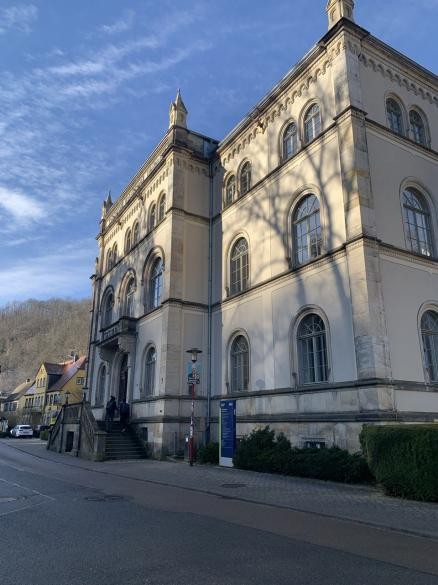
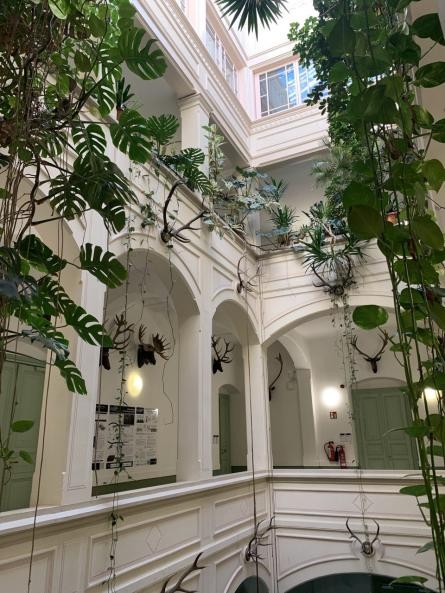
The main building of the Department of Forest Science, TU Dresden in Tharandt
Throughout the programme, participants presented their ongoing research on various methods for mangrove monitoring, including modelling, remote sensing, biodiversity assessments, and socioecological studies. Several training workshops were also conducted by field experts, featuring sessions on frameworks for evaluating mangrove rehabilitation projects.
The workshops also highlighted key objectives of the RESCuE initiative, which aims to strengthen mangrove conservation through science-based, locally relevant approaches. These include developing decision-support tools for monitoring species diversity using satellite, drone, and ground-based data; enhancing rehabilitation practices through modelling techniques such as agent-based simulations; establishing long-term environmental sensor networks to monitor forest dynamics; assessing ecosystem services in both natural and restored mangroves; and improving communication of conservation outcomes to local communities and national agencies.
Nur Hannah presented her research on the second day of the workshop, titled “Status of the Mangroves at Setiu Wetlands: An Assessment of the Vegetation Structure Using Ground Inventory and Remote Sensing Approaches.” She expressed how honoured she felt to present in front of internationally renowned mangrove experts, whose constructive feedback and questions proved highly beneficial to her current and future research.
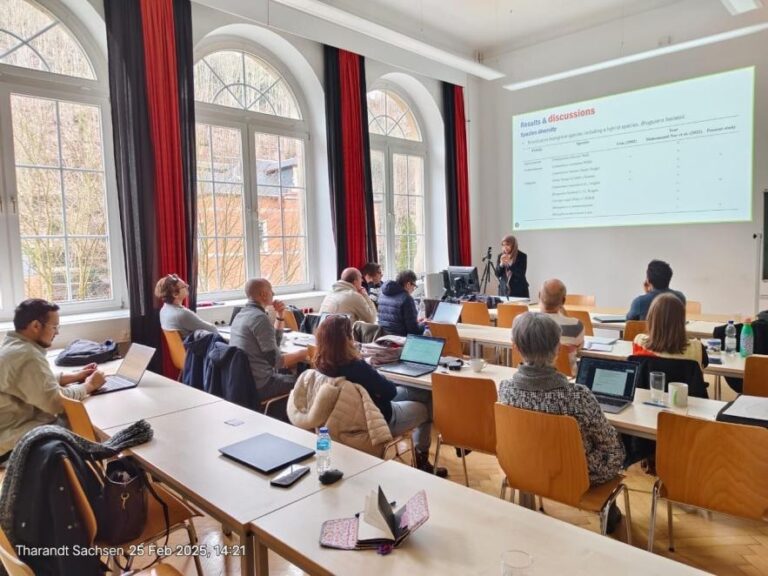
Sharing my passion for mangrove conservation with international experts at the RESCuE Workshop in Tharandt, Germany.
One of the highlights of the workshop included a visit to the Tharandt Forest Botanical Garden, founded in 1811 and one of the oldest scientific collections of woody plants in the world. Home to over 3,200 plant taxa, the garden also houses tropical plant species within a greenhouse—requiring specialised care and knowledge to maintain. Participants learnt about the garden’s operations and its future development plans.
The workshop concluded with a productive brainstorming session, focusing on future collaboration opportunities among the participating researchers from various parts of the world. For Hannah, the experience went beyond academic growth. Her travels across Germany—including exploring the historic and multicultural city of Dresden, as well as the vibrant international atmosphere of Frankfurt—broadened her perspective.
Reflecting on the experience, she quoted Surah al-Ankabut (29:20) from the Quran:
“Say, [O Prophet], ‘Travel throughout the land and see how He originated the creation. Then Allah will bring it into being once more. Indeed, Allah is Most Capable of everything.”
Nur Hannah expressed her deepest gratitude to her main supervisor, Assoc. Prof. Dr. Behara Satyanarayana, her co-supervisors, and the directors and staff of INOS, as well as the teams at the UMT International Centre and UMT Research Management Office. She also thanked her family and friends for their continuous support and guidance. Alhamdulillah, she noted, for the opportunity to learn, grow, and represent UMT on an international platform.