Awarded Master’s Degree
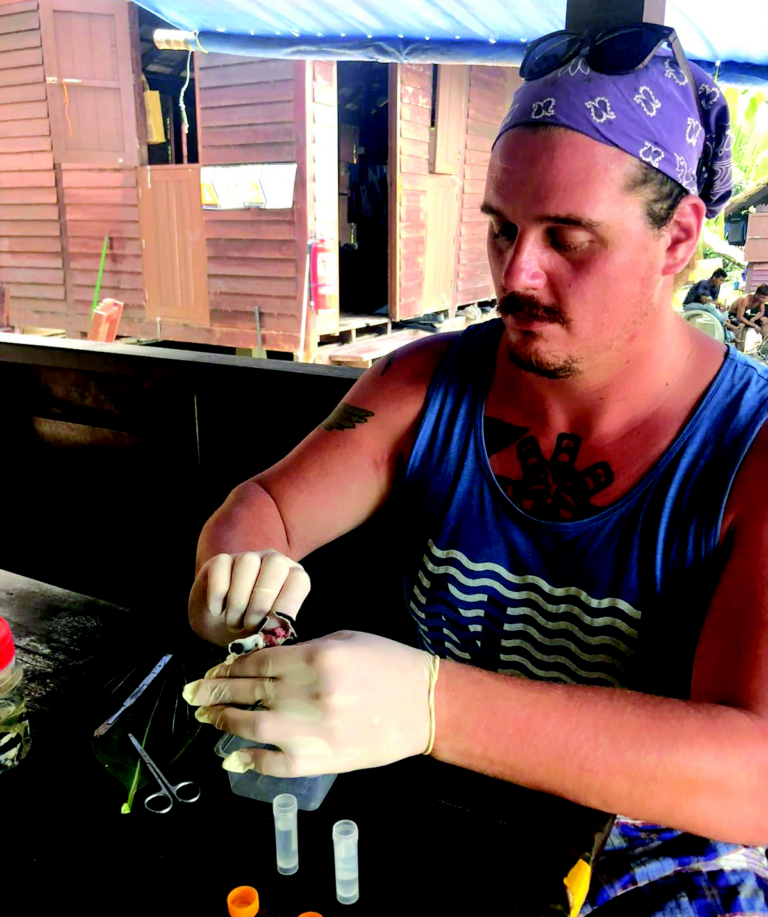
Nicholas carried out his project as a postgraduate student at INOS and completed his Master of Science (Zoology) in June 2021.
He considered himself fortunate to have two supportive parents who understand his dream of studying marine biology abroad. “Malaysia, however, is roughly on the opposite side of the globe from New York, so it’s a long and expensive flight for me to return home,” he said.
The significance of his study towards the conservation of sea turtles is quite big. One of the major contributors to the population decline and local extinction of nesting leatherback turtles in Terengganu is the unattended feminization of hatchlings, said Nicholas.
Although the Malaysian government enacted hatchery management programmes to conserve and protect its dwindling leatherback turtles, they did not understand the effect incubation temperature has on the resulting sex ratio of hatchlings, he said. Over multiple decades of relocating eggs into open beach hatcheries, they produced female-biased hatchlings leading to the collapse of the local nesting population, he added.
His study determined the same trend of feminized hatchling production for green turtles in the region and suggested hatchery management solutions, like adding natural shade materials to help lower incubation temperature inside the Perhentian hatchery and help produce higher proportions of male hatchlings.
When he first started his research, Nicholas was fully aware of the challenges that would come with working on a conservation project such as his, as change would come gradually. To occupy his time between research activities, he built or fixed stuff for his project.
“Seeing a physical change can bring me a lot of personal satisfaction,” he said. “So, I spent time creating new beach chairs, or even changing a broken faucet.”
Staying Put in Malaysia
After completing his master’s degree, Nicholas decided to remain in Malaysia. He admitted that the friendliness of the Malaysian people and the deliciousness of the local food kept him here. He is currently pursuing his doctorate degree, also at UMT.
Nicholas said it does not take him much to be happy. Sometimes it can be as simple as succeeding in his research ambitions or helping his colleagues achieve theirs.
For the time he has stayed in Terengganu, he said he is fortunate to have had many great experiences, and he looks forward to having new ones. The best experience according to him may have been eating a lot of fresh Durians at Sekayu Waterfall with his Terengganu friends.
He thinks international students should be open to new experiences and meeting new people. One of the best ways to do that is to have a meal with new acquaintances and familiar colleagues. That is why he believes the first Malay phrase international students should learn is “Jom kita makan!,” which means “Let’s go eat.”
“It’s a great way to be introduced to new foods you may not be brave enough to try for yourself or make a new lasting friendship with someone you may be too shy to approach alone,” he said.
He has become so accustomed to the way of living and the culture here that he has not thought much about what it is like back home.
“But when it’s cold, wet, and rainy here, I miss the comfort of my American lifestyle,” he said.
It is uncertain if Nicholas will call Terengganu his forever home, but he will be at UMT for a while until he obtains his PhD.
Next time a Caucasian man is spotted wearing Baju Melayu and kain pelikat at a nearby area, the odds are high that he is Nicholas Tolen, a UMT student who has embraced the local culture.