Solid waste management has become one of the most important issues, both in academia and non-academic domains for decades. Various dialogues have been organised on how best to solve the issues holistically using sustainable methods and technology.
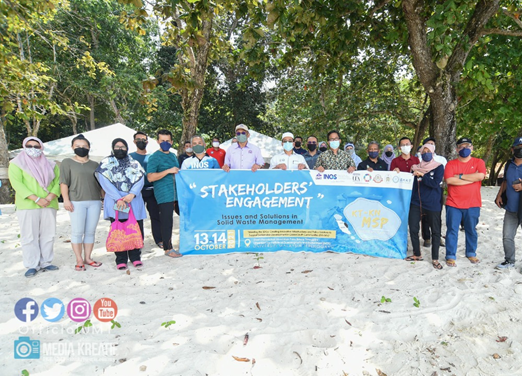
The first UMT – Kuala Terengganu City Council (MBKT) engagement on issues and solutions in solid waste management was held on 13-14 October 2021 at its Pulau Bidong Natural Marine Research Station. The engagement was jointly organised by INOS and MBKT. This session was part of Kuala Terengganu-Kuala Nerus Marine Spatial Planning Project, a joint pilot project between INOS and Fujian Institute for Sustainable Ocean (FISO), Xiamen University, China. This engagement session was also partially supported by the UK Global Research Translation Award, as part of microplastics project with University of East Anglia.
This engagement gathered 22 participants from UMT, MBKT and PLANMalaysia Terengganu. The session focused on the potentials of Kuala Terengganu and Kuala Nerus to better institutionalise and nurture sustainable development, using combination of bottom-up and top-down approaches. In addition, the engagement also was used as a platform to (re)introduce UMT experts to MBKT and their possible contributions to the engagement objectives.
Over two days, this platform was used by the participants, including the Kuala Terengganu Mayor, to brainstorm in a very laidback setting. They re-energised the existing thinking on the modalities of sustainable methods and development as well as encouraged MBKT to shape new inter-agency cooperation initiatives. Among the most important concrete initiatives discussed were mechanisms on solid waste management and policy development. In addition, the engagement assessed the need for regular meetings of MBKT-UMT. Some of these notions were also picked up at the engagement’s closing session by YB Ahmad Shah Muhamed, Deputy Chairman of the Local Government, Housing, Health and Environmental of Terengganu of practical ways that UMT and the State Government of Terengganu could foster sustainability as a key objective in policy-making.
A resolution was presented before YB Ust. Ahmad Shah Muhamed, Mayor Tn. Hj. Rozali Salleh, and Vice Chancellor UMT, Prof. Dr. Mazlan Abd Ghaffar during the closing ceremony. The suggestions and resolutions detailed out are generally not new and grandeur. But, they are promising – practical, achievable, sustainable and future-oriented. The hope is that the resolution could eventually make significant contribution to the current and future sustainable development strategies adopted by MBKT. The holistic approach to transform the city now begins.