






Marine Coastal and Delta Sustainability for Southeast Asia (MARE)

UMT - ERASMUS + MARE RESEARCH PROJECT

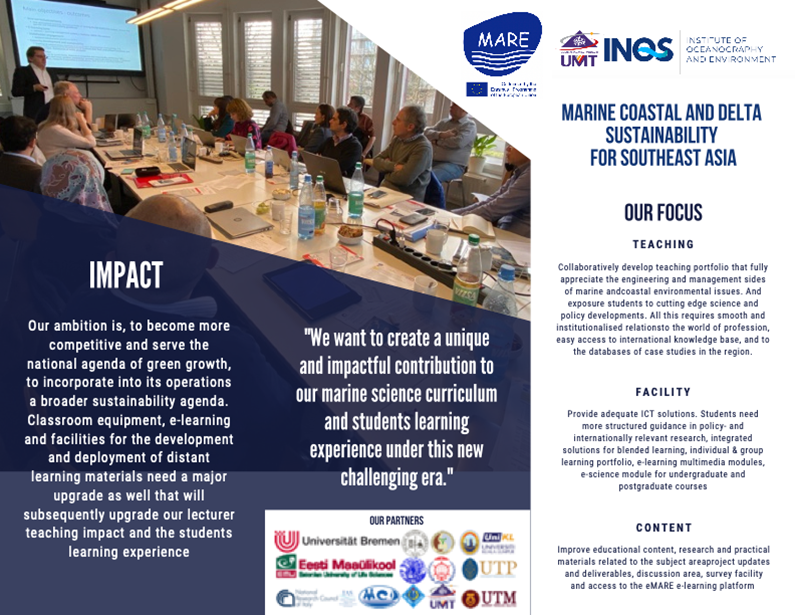
The project aims to provide support to academicians in Asian higher education institutions (HEIs) to design and implement new and improvised syllabus of courses related to the marine environment and sustainability. The issue is highlighted in the project as the marine ecosystem and sustainability has become an environmental governance challenge in the Asian partner countries.

The development of syllabus and module will enable HEIs organisations to align their course content and learning programme strategy with requirements of the current law and regulation related to the issues of marine sustainability. The chosen courses for the project will cover the topics of coastal sciences, delta science, area-based management, fisheries, seabed resources and food security, offshore, exploration and mining and marine pollution.

Other aims of the project are to strengthen the networking between HEIs to promote blended online learning for the courses.  The partners will collaborate in minimizing the skills and facility gap and provide platform for variety of interactive e-learning tools, reading, audio-visuals, case study collections and regular webinars related to the courses. This is due to the high demand of e-learning platform for future ready education.

The main concept of MARE is to encourage sustainable governance and management of coastal, delta & marine (CDM) socio-ecological systems in the Asian partner and adjacent waters through ICT-enhanced tertiary education.

To address this need, Erasmus+ has financially supported MARE projects through cooperation for innovation and the exchange of good practices as part of the “Capacity Building in the Field of Higher Education” project. The project which is coordinated by University of Bremen, Germany has been awarded €968,844.00 over a three-year project duration.

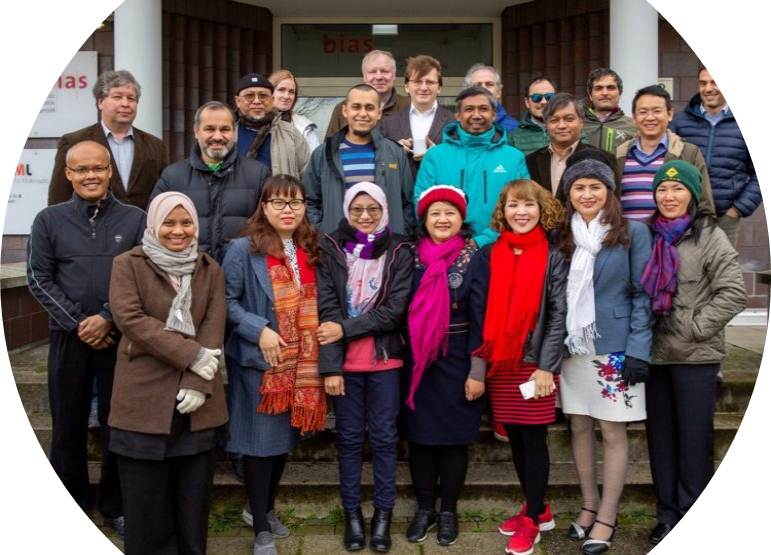
The HEIs partnership project is a collaboration between three European partners: Germany, Italy and Estonia and two Asian partners: Vietnam and Malaysia.

Project Partners

EUROPEAN COUNTRIES:

  • University of Catania (UNICT)
  • Estonian University of Life Sciences (EMU)
  • Institute of Anthropic Impact and sustainability in marine Environment (CNR)
  • University of Bremen (UNIHB)

MALAYSIA:

  • Universiti Kuala Lumpur (UNIKL)
  • Universiti Teknologi Malaysia (UTM)
  • Universiti Teknologi PETRONAS (UTP)
  • University Malaysia Terengganu (UMT)

VIETNAM:

  • Ho Chi Minh City University Of Natural Resources and Environment (HCMUNRE)
  • Vietnam Maritime University (VMU)
  • Centre for Marine life Conservation and Community Development (MCD)
  • College of Environment and Natural Resources

For additional information, please refer to this website :

https://mareumt00.wixsite.com/mare-umt

*The European Commission’s support for the production of this publication does not constitute an endorsement of the contents, which reflect the views only of the authors, and the Commission cannot be held responsible for any use which may be made of the information contained therein.

Abstract

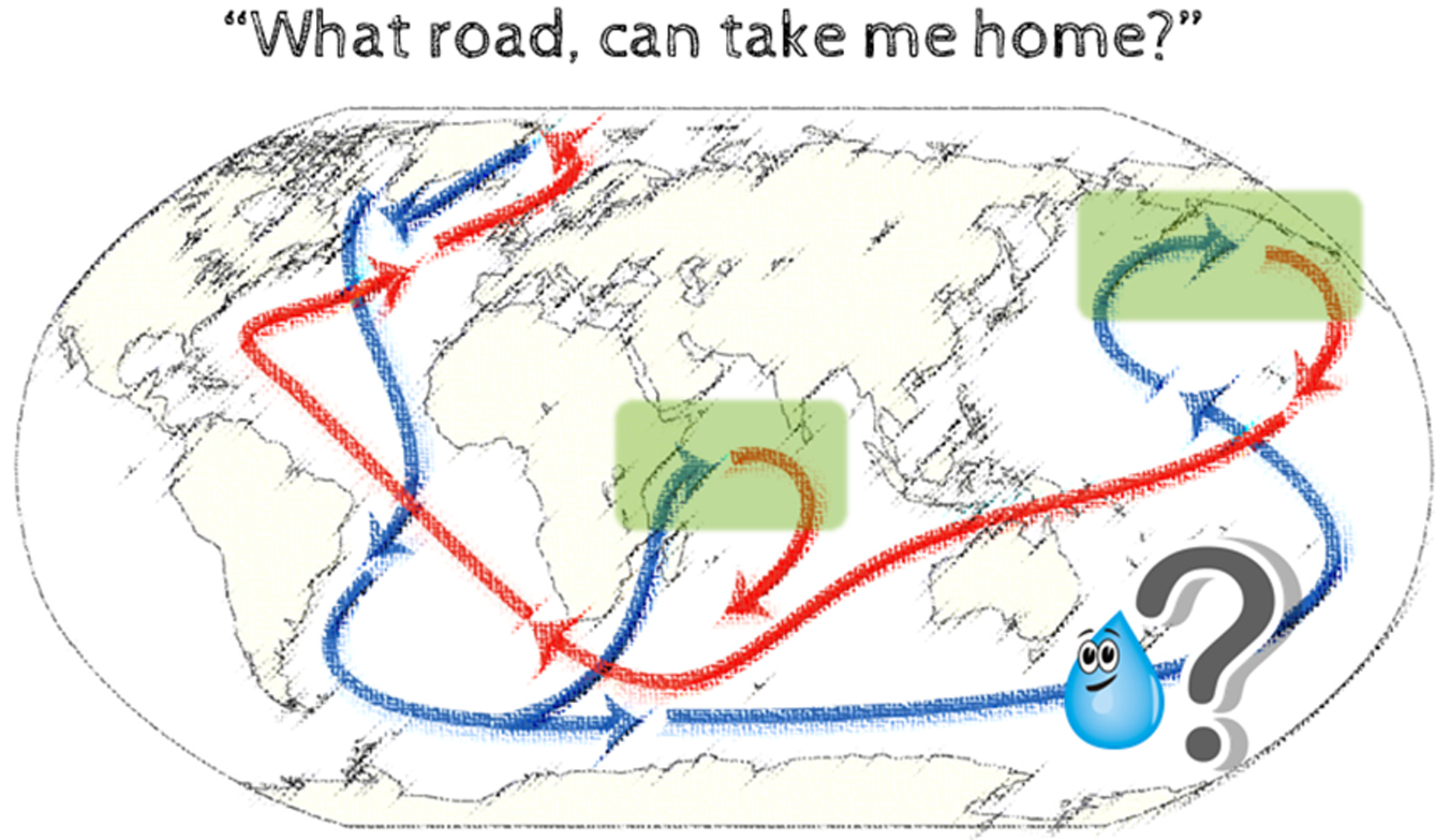
While the sinking formation of Antarctic Bottom Water (AABW) is well understood, how this bottom water "returns home" through upwelling within ocean basins, particularly the Indo-Pacific, remains shrouded in uncertainty. In the 1960s, Munk’s classic "Abyssal Recipes" theory sought to explain these abyssal flows, yet later observations exposed two significant conflicts with real-world data. In 2016, Ferrari, McDougall, and colleagues proposed the "Towards a New Abyssal Recipe" framework, introducing bottom boundary layer (BBL) upwelling to address Munk’s inconsistencies. Drawing on recent evidence of a potential cooling trend in the deep ocean, this talk revisits these debates, offering a fresh interpretation of Munk’s discrepancies and proposing a new mechanism for abyssal upwelling in the Indo-Pacific. It contributes to the ongoing quest to unravel how bottom waters complete their global journey.
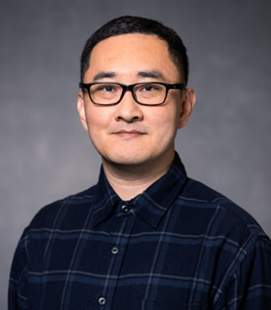
Presented by: Prof. Dr. HAN Lei
Affiliation: China-ASEAN College of Marine Science, Xiamen University, Malaysia
Address: Sepang, Selangor, Malaysia


This will close in 0 seconds

MARE

MARE is an Erasmus+ CBHE project (2020 – 2023) aims to develop adaptive, end-user-oriented and internationally-relevant curricula to support sustainable management and governance of coastal and adjacent marine areas of partner countries Malaysia and Vietnam.

For additional information, please refer to this website :

https://mareumt00.wixsite.com/mare-umt